Hidden Heroes: Uncovering Claudette Colvin’s Role in Changing History
Explore the activism of youth civil rights leader, Claudette Colvin, and how she contributed to the advancement of the Civil Rights Movement.
Lesson Plan
This lesson brings forward the stories of Black women and girls whose activism and leadership were key to the success of the Montgomery Bus Boycott.
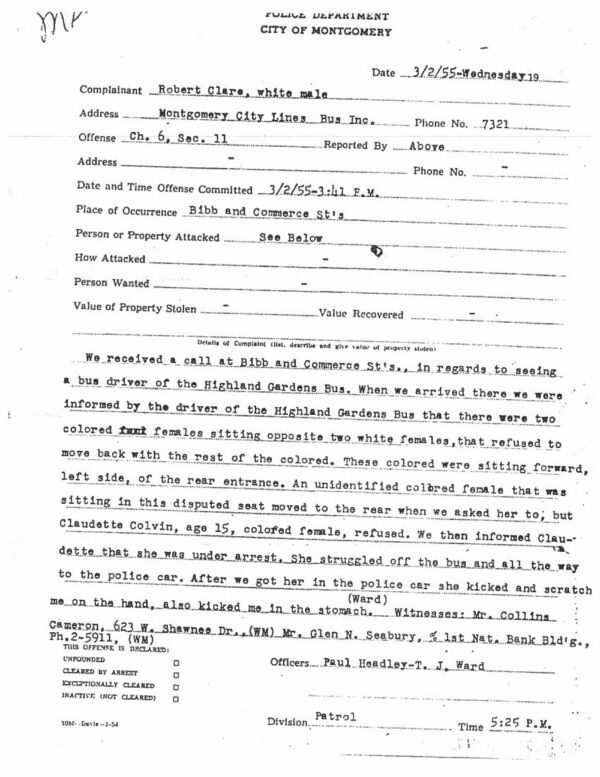
On December 1, 1955, 42-year-old Rosa Parks refused to give up her seat to a white man on a bus in Montgomery, Alabama. As a result, she was arrested for disorderly conduct and disobeying Alabama’s segregation laws. Parks’ courageous act sparked the elevation of the Civil Rights Movement and recognition of Dr. Martin Luther King, Jr. as the movement’s most prominent leader and speaker. While Parks and King are rightfully acknowledged for the key roles they played in the Montgomery Bus Boycott, they were not the only leaders of this pivotal action. Hundreds of Montgomery’s Black women and girls were involved in the planning and execution of this monumental example of collective action. Learn about Jo Ann Robinson, who was verbally assaulted for refusing to move from the “Whites Only” section of the bus in 1949, Claudette Colvin, who was arrested just six-months prior to Parks’ famous detention, and other key women who made the Montgomery Bus Boycott a success.
Eleventh, Ninth, Tenth, Twelfth
Arts, Civics, Engineering, Social Studies, US History
180 minutes
Three 60-minute class periods
Activities, Background Essay, Biographies, Glossary, Primary Sources, Rubric, Secondary Sources, Timeline
At the end of this lesson students will be able to:
It will be helpful for students to be familiar with:
Georgia
SSCG6: Analyze the meaning and importance of each of the rights guaranteed under the Bill of Rights and how each is secured.
SSCG7: Demonstrate knowledge of civil liberties and civil rights.
L9-10RHSS1: Cite specific textual evidence to support analysis of primary and secondary sources, attending to such features as the date and origin of the information.
L9-10RHSS3: Analyze in detail a series of events described in a text; determine whether earlier events caused later ones or simply preceded them.
L9-10RHSS10: By the end of grade 10, read and comprehend history/social studies texts in the grades 9–10 text complexity band independently and proficiently.
L9-10WHST2: Write informative/explanatory texts, including the narration of historical events, scientific procedures/ experiments, or technical processes.
L11-12RHSS1: Cite specific textual evidence to support analysis of primary and secondary sources, connecting insights gained from specific details to an understanding of the text as a whole.
L11-12RHSS3: Evaluate various explanations for actions or events and determine which explanation best accords with textual evidence, acknowledging where the text leaves matters uncertain.
L11-12RHSS7: Integrate and evaluate multiple sources of information presented in diverse formats and media (e.g., visually, quantitatively, as well as in words) in order to address a question or solve a problem.
L11-12RHSS9: Integrate information from diverse sources, both primary and secondary, into a coherent understanding of an idea or event, noting discrepancies among sources.
L11-12RHSS10: By the end of grade 12, read and comprehend history/social studies texts in the grades 11–12 text complexity band independently and proficiently.
L11-12WHST2: Write informative/explanatory texts, including the narration of historical events, scientific procedures/experiments, or technical processes.
Ethnic Studies: Evaluates the contributions African Americans have made to American culture.
To engage in a concerted refusal to have dealings with (a person, a store, an organization, etc.) usually to express disapproval or to force acceptance of certain conditions.
A federal case filed in the U.S. District Court challenging bus segregation in Montgomery and Alabama. The case was filed on behalf of Aurelia Browder, Claudette Colvin, Susie McDonald, and Mary Louise Smith. On June 5, 1956, the District Court decided 2-1 that Montgomery’s bus segregation laws were unconstitutional. The City of Montgomery and State of Alabama appealed, but the Supreme Court affirmed the District Court’s decision on November 13, 1956, subsequently ending the Montgomery Bus Boycott.
Sign in
or
create a free account
to access the full lesson plan and more.
Explore the activism of youth civil rights leader, Claudette Colvin, and how she contributed to the advancement of the Civil Rights Movement.
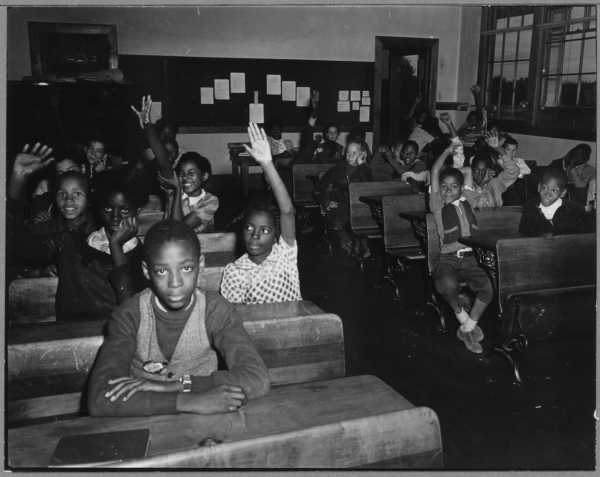
Students explore Investigation Stations to better understand the pivotal Brown v. Board of Education case that recognized the human and civil rights of all students by declaring school segregation unconstitutional.