Hidden in Plain Sight: Black Female Leadership in the Montgomery Bus Boycott
This lesson brings forward the stories of Black women and girls whose activism and leadership were key to the success of the Montgomery Bus Boycott.
1946
The Women’s Political Council was founded in Montgomery, Alabama, by Mary Fair Burks.
1949
Jo Ann Gibson Robinson sat in the “whites only” section of a nearly empty bus and was verbally assaulted by the bus driver. Fearing the assault would become physical, Robinson left the bus.
1950
Jo Ann Gibson Robinson became the president of the WPC and, within a few months, grew the organization to three chapters and more than 300 members.
March 2, 1955
Claudette Austin Colvin was arrested for refusing to give up her seat in the “colored only” section for a white man. Colvin was 15 years old, pregnant, and unmarried.
August 1955
Rosa Parks received a scholarship and travel support to attend the Highland Folk School in Tennessee. Septima Clark led the two-week workshop for labor and civil rights activists. Clark and Parks became close, and the older woman served as a mentor for Rosa.
December 1, 1955
Rosa Parks was arrested for refusing to give up her seat in the “colored only” section for a white man. Parks was 42 years old and a veteran civil rights activist having been the secretary of the NAACP since 1943.
December 5, 1955
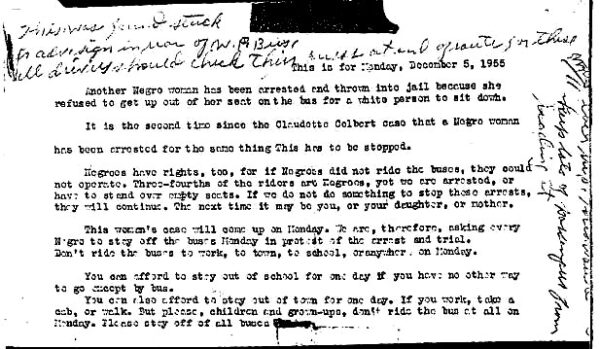
With the leadership of Jo Ann Gibson Roginson, the Women’s Political Council successfully organized a one-day bus boycott. After the boycott, members of the community met to discuss continuing the boycott for a longer period.
December 5, 1955
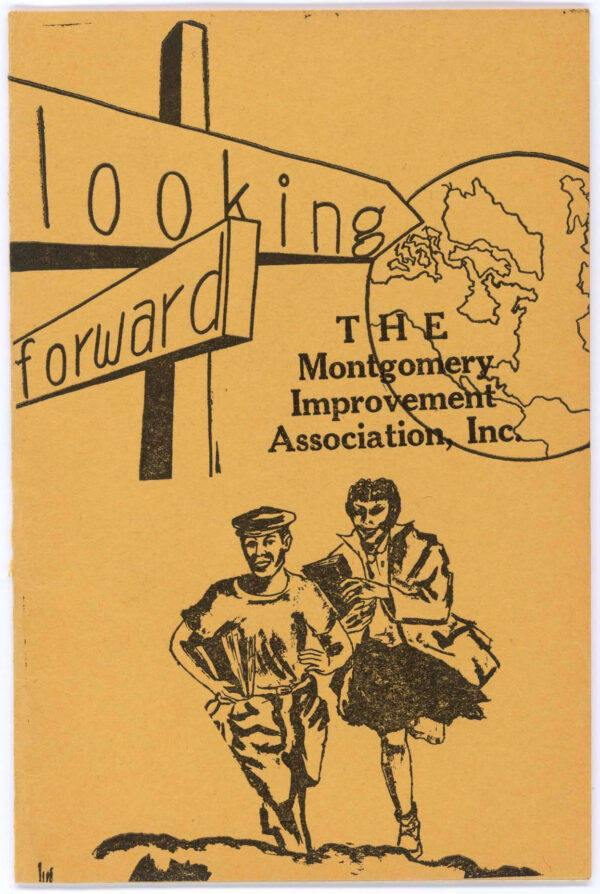
The Montgomery Improvement Association was formed as a grassroots civic organization centered on managing the Montgomery Bus Boycott. Martin Luther King, Jr., was elected as the organization’s president.
February 1, 1956
Browder v. Gayle was filed in the U.S. District Court challenging bus segregation in Montgomery and Alabama. Plaintiffs in the case were Aurelia Browder, Claudette Colvin, Susie McDonald, and Mary Louise Smith. Gayle was the mayor of Montgomery.
June 5, 1956
The District Court decided (2-1) in favor of the plaintiffs in Browder v. Gayle, noting that Montgomery’s bus segregation laws were unconstitutional. The City of Montgomery and State of Alabama appealed.
November 13, 1956
The U.S. Supreme Court affirmed the District Court’s Browder v. Gayle decision, subsequently ending the Montgomery Bus Boycott.
December 20, 1956
Montgomery Bus Boycott ended when The U.S. Supreme Court declared segregated seating on public transportation unconstitutional.
Featured in
This lesson brings forward the stories of Black women and girls whose activism and leadership were key to the success of the Montgomery Bus Boycott.