Walter White: Advocate in Changing Times
This lesson explores the complexity of former NAACP president Walter White’s public views during the Cold War Era and reveals some of the divisions within the civil rights movement as McCarthyism intensified.
July 1, 1893
Walter Francis White is born in Atlanta, Georgia.
June, 1906
White graduated from Atlanta University Laboratory High School.
September 22–24, 1906
Walter White and his family were witnesses of the 1906 Atlanta Race Massacre, a violent outbreak of racial tensions and mob violence targeting the Black community in Atlanta, Georgia. The violence resulted in the deaths of at least 25 people and the destruction of numerous Black businesses and homes.
September, 1912
White begins attending Atlanta University, where he studies sociology and economics.
1914–1918
World War I, also known as the Great War, took place from 1914 to 1918. It was a global conflict primarily centered in Europe, involving many nations from around the world.
June, 1918
White volunteers for the American Red Cross during World War I.
May, 1919
White graduates from Atlanta University with his bachelor’s degree.
1929
Walter White becomes an assistant secretary for the NAACP and moves to New York City.
1931
White is appointed the NAACP’s executive secretary, becoming the first African American to hold that position.
1939
White publishes his memoir, “A Man Called White,” which details his experiences and the civil rights movement.
1944
White is appointed as the executive director of the NAACP, a position he holds for over two decades.
1939–1945
World War II took place from 1939 to 1945. It was a global conflict involving many countries and resulted in significant political, social, and economic changes worldwide.
1948
White helps organize the NAACP’s legal team in the landmark Supreme Court case, Shelley v. Kraemer, which challenged racial housing covenants.
1949
Paul Robeson’s passport is revoked by the U.S. government.
1950–1953
North Korea, supported by the Soviet Union and China, invaded South Korea. The United States and its allies intervened to support South Korea, resulting in a three-year conflict that ended in an armistice.
February 9, 1950
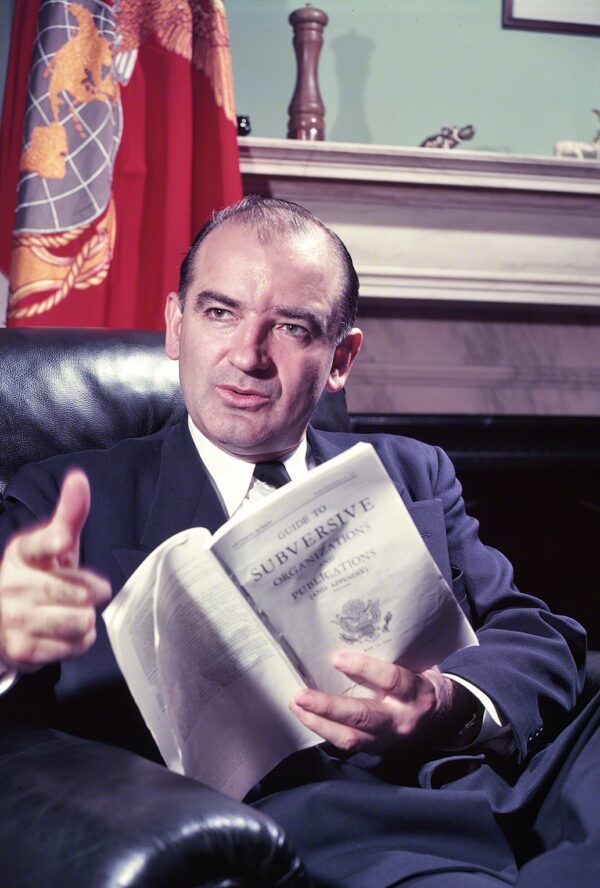
McCarthy gives a speech in Wheeling, West Virginia, where he claims to have a list of known communists working within the U.S. State Department, launching his crusade against alleged communist infiltration.
1954
The Brown v. Board decision declared segregation in public schools unconstitutional.
June 9, 1954
McCarthy accused the U.S. Army of harboring communists, which led to televised hearings that eventually contributed to his downfall.
December 2, 1954
The Senate votes to censure McCarthy for his conduct during the Army-McCarthy hearings. This censure severely damaged his political career and public standing.
1955–1975
The United States supported South Vietnam in its fight against communist North Vietnam and its allies. The war became a major conflict of the Cold War, with the United States trying to prevent the spread of communism in Southeast Asia.
December, 1955
White supports the Montgomery Bus Boycott led by Rosa Parks and Martin Luther King Jr.
May 2, 1957
Joseph McCarthy dies at the age of 48 due to acute hepatitis. His death marks the end of his controversial and divisive political career.
1958
Paul Robeson’s United States passport is reinstated.
1959–1961
Fidel Castro led a successful revolution in Cuba, establishing a communist government. In 1961, the United States attempted to overthrow Castro’s regime through a failed invasion at the Bay of Pigs.
1962
The Soviet Union deployed nuclear missiles in Cuba, which sparked a tense standoff with the United States. It was a critical moment during the Cold War, with the world on the brink of nuclear war. Ultimately, a diplomatic agreement was reached, and the missiles were removed.
August 28, 1963
White participates in the March on Washington for Jobs and Freedom alongside other civil rights leaders.
March 21, 1975
Walter White passes away in New York City, leaving behind a lasting legacy in the fight for racial equality.
Featured in
This lesson explores the complexity of former NAACP president Walter White’s public views during the Cold War Era and reveals some of the divisions within the civil rights movement as McCarthyism intensified.