Primary Source

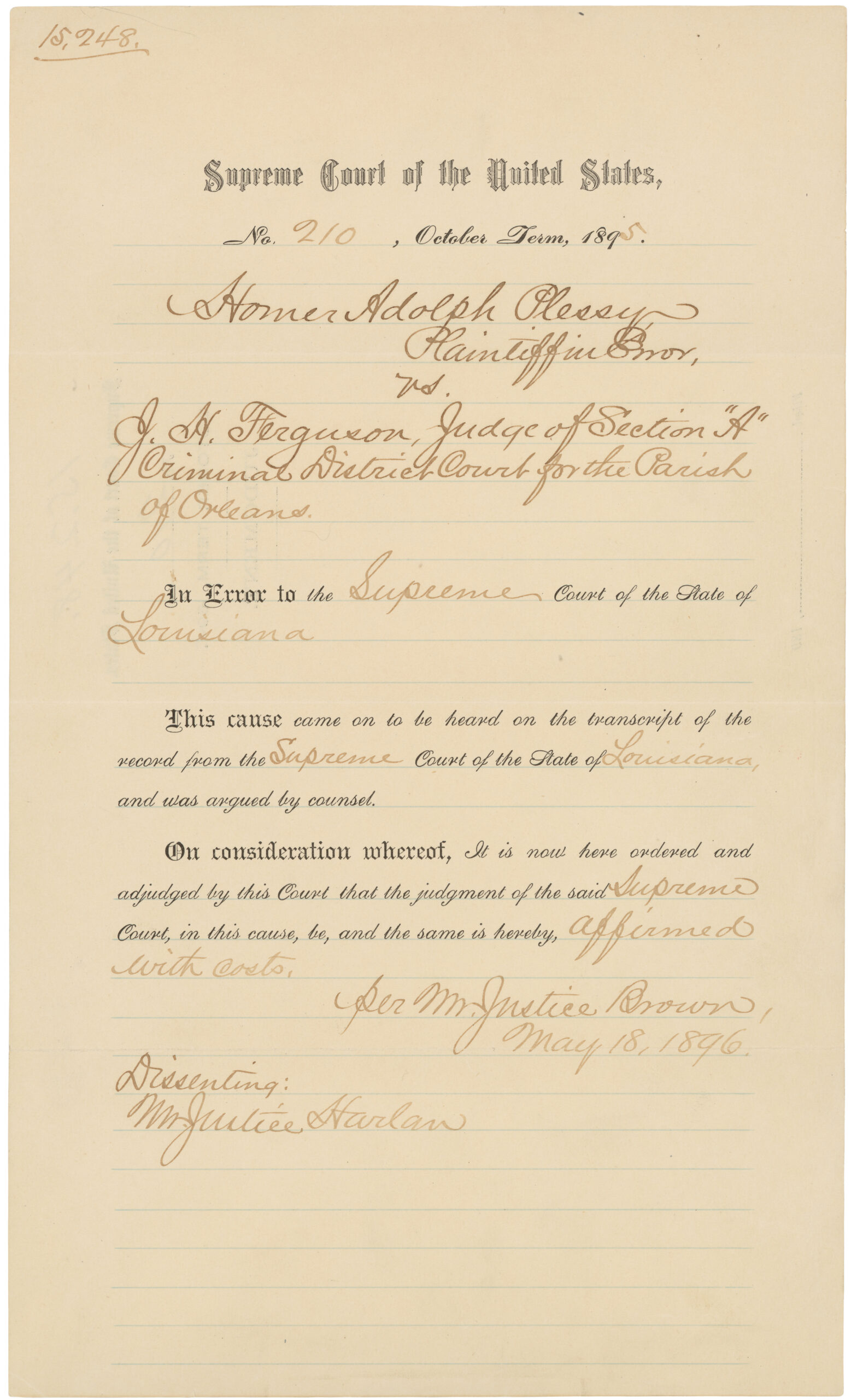
Judgement in Plessy v. Ferguson

Source: The Supreme Court of the United States via the National Archives.

In 1891, a group of concerned young black men of New Orleans formed the “Citizens’ Committee to Test the Constitutionality of the Separate Car Law.” They raised money and engaged Albion W. Tourgée, a prominent Radical Republican author and politician, as their lawyer. On May 15, 1892, the Louisiana State Supreme Court decided in favor of the Pullman Company’s claim that the law was unconstitutional as it applied to interstate travel. Encouraged, the committee decided to press a test case on intrastate travel. With the cooperation of the East Louisiana Railroad, on June 7, 1892, Homer Plessy, a multiracial man (7/8 white), seated himself in a white compartment, was challenged by the conductor, and was arrested and charged with violating the state law. In the Criminal District Court for the Parish of Orleans, Tourgée argued that the law requiring “separate but equal accommodations” was unconstitutional. When Judge John H. Ferguson ruled against him, Plessy applied to the State Supreme Court for a writ of prohibition and certiorari. Although the court upheld the state law, it granted Plessy’s petition for a writ of error that would enable him to appeal the case to the Supreme Court. In 1896, the Supreme Court issued its decision in Plessy v. Ferguson. Justice Henry Brown of Michigan delivered the majority opinion, which sustained the constitutionality of Louisiana’s Jim Crow law.

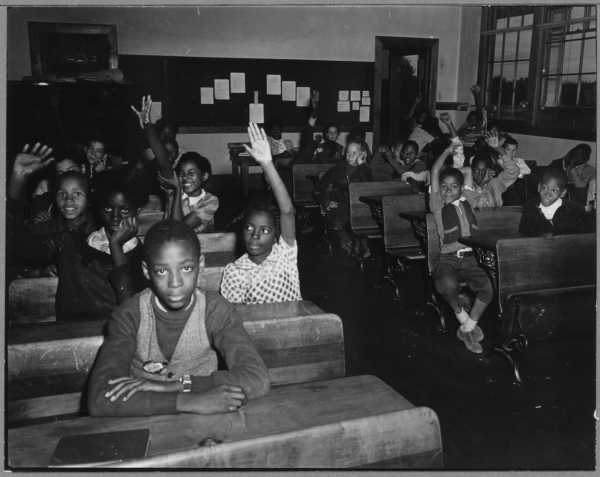
Indeed, it was not until the Supreme Court’s decision in Brown v. Board of Education of Topeka, Kansas and congressional civil rights acts of the 1950s and 1960s that systematic segregation under state law was ended. In the wake of those Federal actions, many states amended or rewrote their state constitutions to conform with the spirit of the 14th Amendment.

Judgement in Plessy v. Ferguson
Source: National Archives.