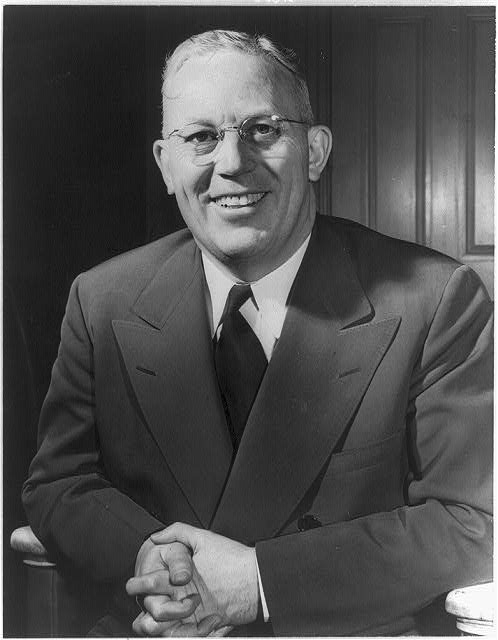
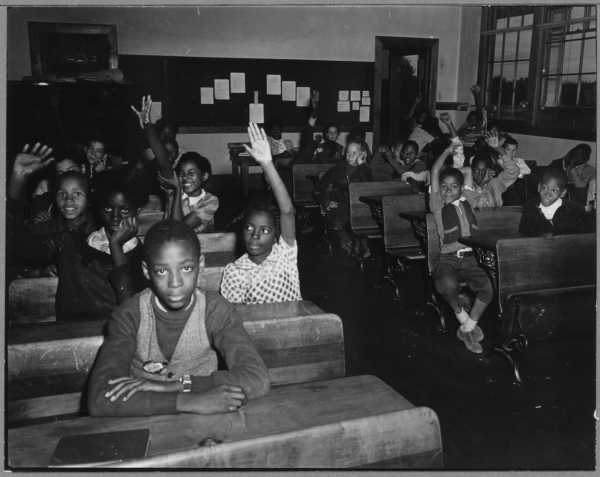
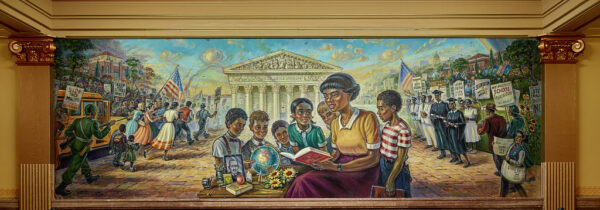
Earl Warren of Los Angeles, California, served as Chief Justice of the U.S. Supreme Court from 1953-1969, a period of tremendous changes in U.S. Constitutional law. Warren’s mother was a Swedish immigrant, and his father worked as a Norwegian immigrant, a railroad repairman who was blacklisted following the Pullman Strike (1894). Warren earned his Bachelor’s and Law degrees from the University of California, Berkeley, then enlisted in 1917 in the U.S. Army during World War I. After the war, Warred worked as District Attorney in Alameda, California, from 1926 until 1939. He was elected state attorney general in 1938 and governor of California in 1942, 1946, and 1950. Republicans nominated Warren as vice presidential candidate in 1948, losing on a ticket with Thomas Dewey. President Dwight. D. Eisenhower nominated Earl Warren as Chief Justice of the U.S. Supreme Court in 1953. In his first term as Chief Justice, Warren spoke for the unanimous court’s ruling of the Brown v. Board of Education of Topeka, stating “separate educational facilities are inherently unequal.” During the tumultuous era of the 1950s and 1960s, Warren’s court ruled on a wide range of issues. Notably, following the assassination of President John F. Kennedy, President Lyndon B Johnson appointed Warren to chair a commission to investigate the murder. Warren retired in 1969 and passed away in 1974. Warren is remembered as an ideological and jurisprudent leader of the consequential “Warren Court.”