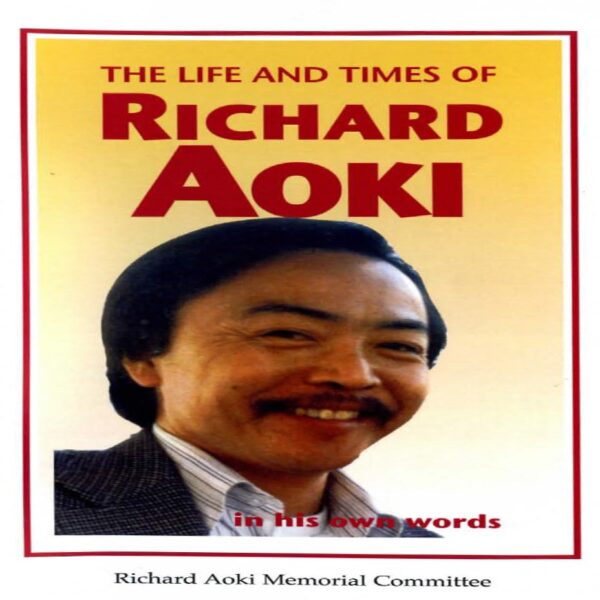
On November 20, 1938, Richard Masato Aoki was born to Shozo Aoki and Toshiko Kaniye in San Leandro, California. Richard was the elder of two children born to his “Nisei” (second-generation) Japanese American parents. Prior to World War II, Aoki and his family lived in the Berkeley, California area. In 1942, however, with the signing of Executive Order 9066 by President Franklin D. Roosevelt, the Aoki family found themselves among the approximately 120,000 American citizens of Japanese descent forcibly relocated to internment camps. The Aoki family was first confined to the Tanforan Assembly Center in San Bruno, California, before being moved to the Topaz War Relocation Authority Camp in Topaz, Utah. The family spent three years in internment camps until their release in 1945. The camps had a significant impact on Aoki’s family. His parents separated and his father quit teaching, saying he could not teach about democracy while being held in an internment camp simply because he was Japanese. Richard witnessed a great deal of violence in the camps; indeed, he got into the first of his many fights while defending his brother, David.
After their release from Topaz War Relocation Camp, Aoki, his brother, and his father settled in West Oakland, California. In his new environment, Aoki lived among people of color with various racial identities, though most of his neighbors were Black families who had moved to California to escape anti-Black racism in the South. Upon hearing their stories, Aoki began connecting his family’s experiences in internment camps to the experiences of Black people in the South and to his observations of police brutality, underemployment, housing issues, etc., ultimately concluding that people of color in the United States were subjected to unequal treatment and systemically denied opportunities to enhance their lives. Such thinking and experiences likely planted the seed for Richard’s work as an activist. This seed would not bloom, however, until after he joined a street gang, graduated high school, and served in the United States Army.
As a young teen, Aoki joined a gang where he was known to be a fearsome fighter. Despite his arrests for shoplifting, burglarizing homes, and stealing car parts, he nevertheless graduated from Herbert Hoover Junior High School as co-valedictorian. Aoki and his brother later moved to Berkeley, California, with his mother after his father abandoned the family. In Berkeley, Aoki thrived academically at Berkeley High School before getting in trouble for assaulting a student in the hallway. In 1957, three days after his high school graduation, Aoki reported to Fort Ord, near Monterey, California, as an enlisted soldier in the United States Army. Aoki did not see combat while enlisted but did become a firearms expert. He served for one year on active duty and seven years in the Army Reserve before being honorably discharged as a sergeant. In a 2007 interview, Aoki revealed his service in the Army was part of a deal he cut with authorities to keep his criminal record sealed.
During his time in the Reserve, Aoki became an FBI informant, reporting primarily to Special Agent Burney Threadgill, Jr. until 1965 and to other agents thereafter. Threadgill contended that Aoki’s involvement in several leftist groups – the Communist Party, the Socialist Workers Party, the Young Socialist Alliance, and the Vietnam Day Committee, to name a few – was a direct result of his role as an FBI informant. Much of Aoki’s reported role as an FBI informant centered on the Black Panther Party for Self Defense, a Black Power and community-centered organization founded by Bobby Seale and Huey P. Newton in 1966. Aoki met Seale and Newton at Merritt College in Oakland, California. The pair were members of the Soul Students Advisory Council of Associated Students of Merritt Jr. College, an intellectualized group whose work centered on examining the issues of Black people and people of color.
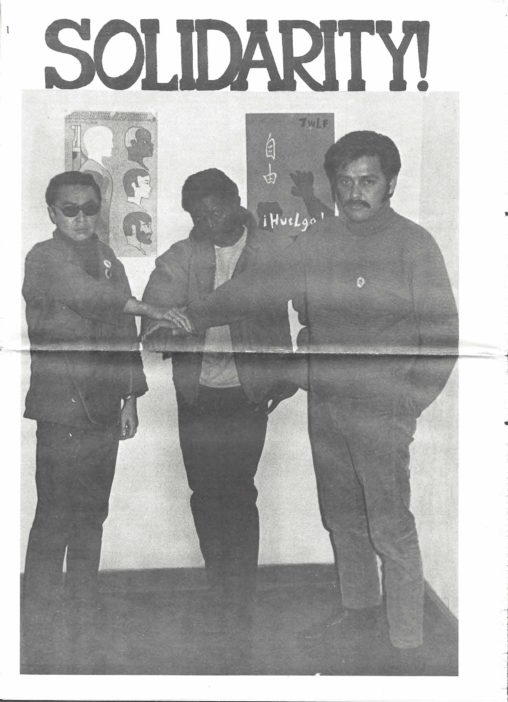
In 1966, after Aoki transferred to University of California at Berkeley, Seale and Newton joined him at his apartment to discuss their 10-point program calling for improved housing, education, employment, release of incarcerated Black men, an end to police brutality, and elimination of capitalist exploitation of the Black community. The 10-point program was the foundation for what later became the Black Panther Party for Self Defense. Aoki officially joined the Panthers in 1967. In a 2007 interview, Aoki explained that after Newton asked him to join the Panthers and Aoki reminded Newton that he was not Black, Newton said, “I know you’re not black, Richard, but I’m asking you to join because the struggle for freedom, justice and equality transcends racial and ethnic barriers.” Aoki was involved with the Black Panther Party for Self Defense from its inception, holding the ranks of Field Marshal and Minister of Education at different times. According to Bobby Seale, Aoki also supplied the Panthers with their first guns and provided firearms training for new recruits.
In 2012, a report by journalist Seth Rosenfeld alleged Aoki was an FBI informant for 16 years (from 1961-1977), having provided intelligence on the Communist Party, the Socialist Workers’ Party, and the Black Panther Party. Among the details in Rosenfeld’s report are that a 1967 FBI intelligence report listed Aoki as informant “T-2”, and that his full 221-page informant file listed him as both “T-2” and “Richard Ford.”
In 2009, Aoki placed his United States Army and Black Panther Party uniforms on his bed before taking his own life.