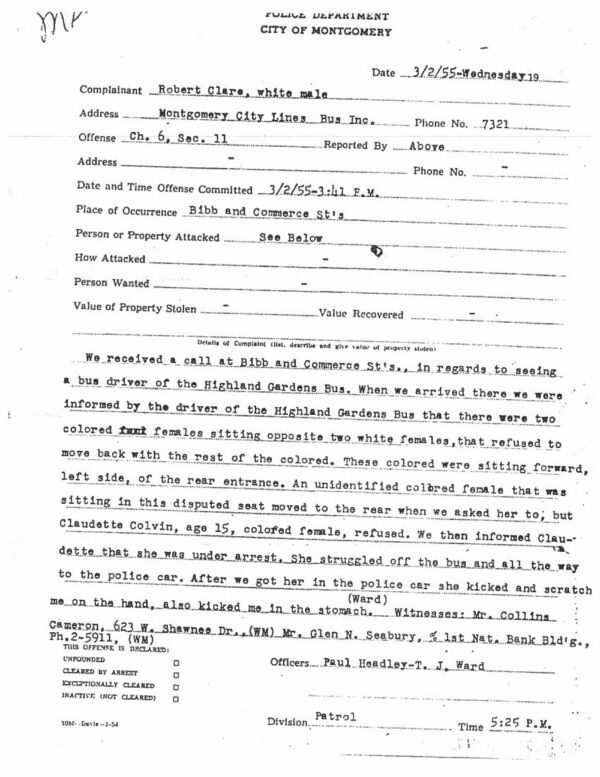
Hidden Heroes: Uncovering Claudette Colvin’s Role in Changing History
Explore the activism of youth civil rights leader, Claudette Colvin, and how she contributed to the advancement of the Civil Rights Movement.

Lesson Plan
Students will enhance their skills in historical analysis, chronological organization, and storytelling through the guided exploration of a collection of primary sources highlighting the Stonewall Uprising and its lasting impact on the fight for equality.
The Stonewall Uprising, which unfolded in the early hours of June 28, 1969, marked a pivotal moment in the LGBTQ+ rights movement. Situated in the Greenwich Village neighborhood of New York City, the Stonewall Inn, a popular gay bar, became the epicenter of resistance against systemic oppression and police harassment. The event was triggered by a police raid on the bar, but instead of dispersing quietly, the patrons and members of the LGBTQ+ community fought back, sparking days of protests and clashes with law enforcement. The Stonewall Uprising is often considered the catalyst for the modern LGBTQ+ rights movement, symbolizing a collective demand for equality, dignity, and liberation. This lesson explores the historical context, the key figures involved, and the lasting impact of Stonewall on the fight for LGBTQ+ rights worldwide.
Eleventh, Tenth, Twelfth
Arts, Civics, Social Studies, US History
120 minutes
Two 60-minute class periods
Activities, Background Essay, Biographies, Glossary, Primary Sources, Rubric, Secondary Sources, Timeline
At the end of this lesson students will be able to:
It will be helpful for students to be familiar with:
Georgia:
SSSocIC1: Analyze forms of social inequality.
SSCG7: Demonstrate knowledge of civil liberties and civil rights.
ELAGSE11-12RI1: Cite strong and thorough textual evidence to support analysis of what the text says explicitly as well as inferences drawn from the text, including determining where the text leaves matters uncertain.
ELAGSE11-12RI2: Determine two or more central ideas of a text and analyze their development over the course of the text, including how they interact and build on one another to provide a complex analysis; provide an objective summary of the text.
ELAGSE11-12RI3: Analyze a complex set of ideas or sequence of events and explain how specific individuals, ideas, or events interact and develop over the course of the text.
ELAGSE11-12RI7: Integrate and evaluate multiple sources of information presented indifferent media or formats (e.g., visually, quantitatively) as well as in words in order to address a question or solve a problem.
ELAGSE11-12W1: Write arguments to support claims in an analysis of substantive topics or texts, using valid reasoning and relevant and sufficient evidence.
ELAGSE11-12W2: Write informative/explanatory texts to examine and convey complex ideas, concepts, and information clearly and accurately through the effective selection, organization, and analysis of content.
ELAGSE11-12W7: Conduct short as well as more sustained research projects to answer a question (including a self-generated question) or solve a problem; narrow or broaden the inquiry when appropriate; synthesize multiple sources on the subject, demonstrating understanding of the subject under investigation.
ELAGSE11-12W8: Gather relevant information from multiple authoritative print and digital sources, using advanced searches effectively; assess the strengths and limitations of each source in terms of the task, purpose, and audience; integrate information into the text selectively to maintain the flow of ideas, avoiding plagiarism and overreliance on any one source and following a standard format for citation.
The behavioral, cultural, or emotional traits typically associated with one biological sex.
A person’s internal sense of being male, female, a combination of male and female, or neither male nor female.
Sign in
or
create a free account
to access the full lesson plan and more.
Explore the activism of youth civil rights leader, Claudette Colvin, and how she contributed to the advancement of the Civil Rights Movement.
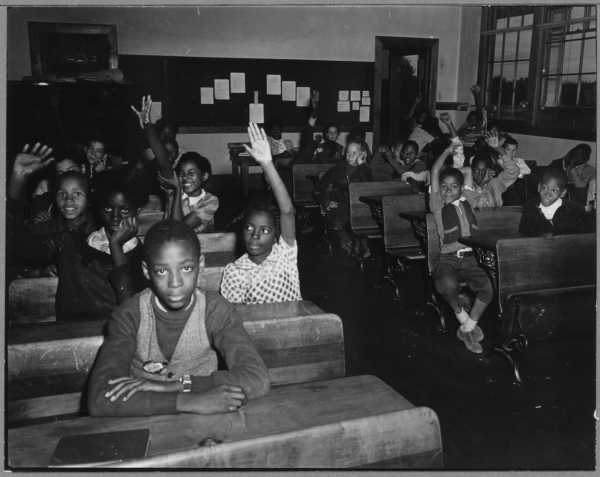
Students explore Investigation Stations to better understand the pivotal Brown v. Board of Education case that recognized the human and civil rights of all students by declaring school segregation unconstitutional.