Human Rights 101: The Universal Declaration of Human Rights
In this lesson, students will learn how human rights differ from civil rights and gain introductory knowledge of how the international community united to define and defend human rights.
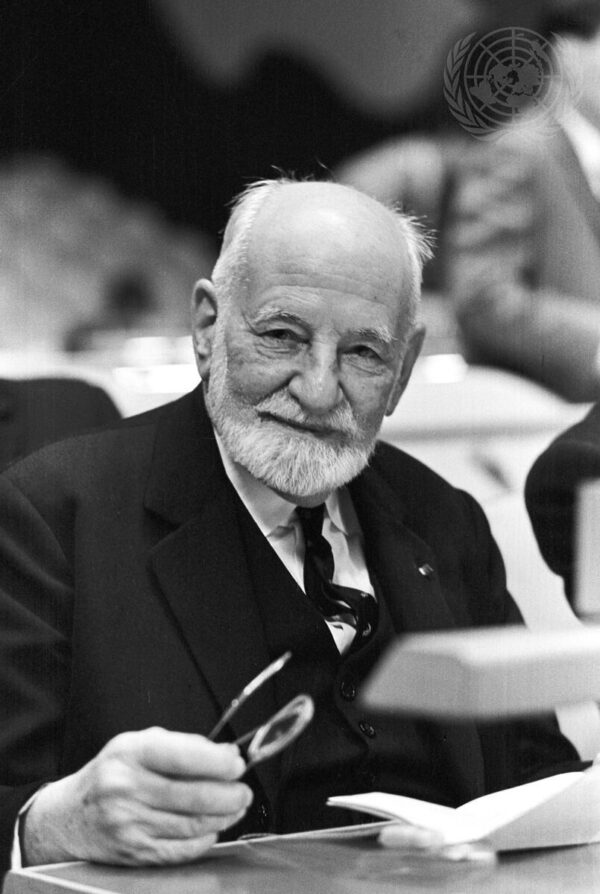
René Cassin was an international human rights advocate, noted legal scholar, and Noble Peace Prize winner. Cassin was born in Bayonne, France in 1887 to Gabrielle Dreyfus and Henri Cassin. He received degrees in both humanities and law from the University of Aix-en-Provence in 1908 and in 1914 he earned his doctorate. Cassin could not relish his academic accomplishments for long, however, as he was soon inducted into the French infantry and sent to the battlefield of World War I. In 1916 he was severely wounded by German shrapnel and was discharged the same year.
From 1916 through 1960, Cassin taught law at various universities across France. In 1918 he founded the French Federation of Disabled War Veterans and served on the High Council for Wards of the Nation. His humanitarian work expanded beyond the borders of France by 1924 when he served as a French delegate to the League of Nations. Cassin continued as a League of Nations delegate through 1938 and naturally became one of the French delegates to the United Nations upon its creation. In 1968 René Cassin received a Noble Peace Prize in honor of his work to establish the Universal Declaration of Human Rights, his service on the Human Rights Commission (1946-1959) and his service as the President of the European Court for Human Rights.
Featured in
In this lesson, students will learn how human rights differ from civil rights and gain introductory knowledge of how the international community united to define and defend human rights.